Expense Categorization: A Complete Guide for Small Businesses
 Admin4 min read
Expense categorization enables small businesses to track their spending, enhance tax accuracy, and achieve financial clarity. This complete guide explains what it is, why it matters, and how to do it right.
Introduction
For many small businesses, expenses are tracked—but not always organized. Receipts pile up, spreadsheets grow messy, and at tax time, business owners struggle to understand where their money actually went.
Expense categorization is the foundation of accurate bookkeeping, financial reporting, and smarter business decisions. When combined with processes like receipt digitization, it gives small businesses clarity and control over their finances.
This guide explains expense categorization in simple terms and shows how small businesses can manage it efficiently.
What Is Expense Categorization?
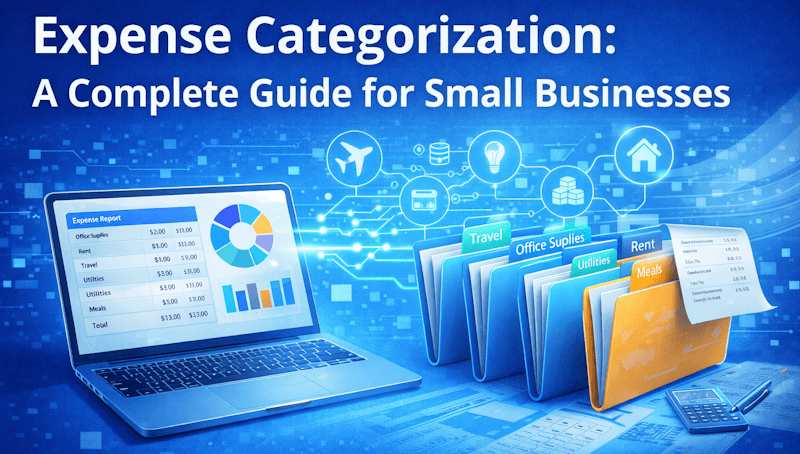
Expense categorization is the process of grouping business expenses into predefined categories such as:
Office supplies
Travel
Meals & entertainment
Utilities
Software subscriptions
Each expense is assigned a category so it can be tracked, analyzed, and reported correctly.
This process becomes much easier when businesses can extract expense data from receipts and invoices automatically instead of entering it manually.
Why Expense Categorization Matters for Small Businesses
1. Better Financial Visibility
Categorized expenses help business owners understand:
Where money is being spent
Which costs are increasing
Which areas can be optimized
Without categorization, expenses remain numbers without context.
2. Accurate Tax Reporting
Tax authorities often require expenses to be reported by category. Proper categorization:
Reduces tax errors
Prevents missed deductions
Makes audits easier
This is especially important when dealing with taxes like GST/VAT extraction, where accuracy directly impacts compliance.
3. Simplified Bookkeeping
Well-categorized expenses reduce back-and-forth with accountants and save time during month-end and year-end reporting.
4. Smarter Business Decisions
When expenses are categorized, businesses can:
Control overspending
Forecast budgets accurately
Measure profitability by cost area
Common Expense Categories for Small Businesses
While categories vary by industry, most small businesses use:
Rent & utilities
Office supplies
Travel & transportation
Meals & entertainment
Marketing & advertising
Software & subscriptions
Professional services
Having consistent categories is more important than having many categories.
Common Challenges With Manual Expense Categorization
Many small businesses still categorize expenses manually, leading to issues such as:
Inconsistent category names
Misclassified expenses
Missing receipts
Time-consuming data entry
Errors during tax filing
As expense volume grows, these problems multiply.
How Expense Categorization Works
Step 1: Capture Expenses
Expenses are captured from:
Receipts
Invoices
Bank statements*
Step 2: Assign Categories
Each expense is assigned a category based on:
Vendor type
Transaction description
Business purpose
This can be done manually or automatically.
Step 3: Review & Validate
Expenses should be reviewed periodically to ensure:
Correct categorization
No duplicates
Compliance with accounting rules
Manual vs Automated Expense Categorization
Manual Categorization
Time-consuming
Prone to errors
Difficult to scale
Automated Categorization (AI-Powered)
Faster and more consistent
Learns from past patterns
Reduces manual workload
This approach aligns closely with AI-powered expense automation, which is becoming the standard for modern businesses.
How DocuNero Helps With Expense Categorization
DocuNero uses AI-powered document analysis to extract expense data from receipts, invoices, and statements, then classifies them into structured categories.
Key benefits include:
Automatic extraction of expense details
Consistent categorization across documents
Reduced manual data entry
Ability to export expense data to Excel or CSV
This helps small businesses maintain clean, accurate financial records with minimal effort.
Who Should Prioritize Expense Categorization?
Expense categorization is essential for:
Small business owners
Freelancers and consultants
Startups
Finance and accounting teams
Any business that wants clearer financial insights benefits from structured expense tracking.
Best Practices for Small Businesses
Use consistent expense categories
Categorize expenses regularly (not once a year)
Keep digital copies of receipts
Review expense reports monthly
Adopt tools that scale as your business grows
When Should You Automate Expense Categorization?
Automation becomes valuable when:
Expense volume increases
Manual categorization causes delays
Errors appear in financial reports
Tax preparation becomes stressful
At this stage, businesses often move toward automating expense management to save time and improve accuracy.
Conclusion
Expense categorization is more than an accounting task—it’s a key driver of financial clarity for small businesses. Without it, spending becomes difficult to track and even harder to control.
By categorizing expenses correctly and consistently, small businesses gain better visibility, improve tax accuracy, and make smarter financial decisions. With AI-powered tools now available, expense categorization no longer needs to be manual or time-consuming.
For small businesses looking to grow sustainably, structured expense categorization is a simple but powerful place to start.
Ready to get started with DocuNero?
Join thousands of users who trust us to automate their invoices and receipts with AI.
Start Free with DocuNeroAdmin
Admin at DocuNero, helping users simplify invoice and receipt processing through AI-powered automation.
View all posts by Admin