Understanding GST/VAT Extraction: What Every Business Should Know
 Admin3 min read
GST and VAT extraction is critical for accurate tax reporting and compliance. Learn how it works, common challenges, and how automation improves accuracy.
Introduction
Taxes like GST (Goods and Services Tax) and VAT (Value Added Tax) are a fundamental part of business transactions worldwide. Every invoice typically includes tax amounts that must be recorded accurately for reporting, reconciliation, and compliance.
However, extracting GST or VAT data manually from invoices is often time-consuming and error-prone—especially when dealing with high invoice volumes or multiple tax rates.
This guide explains what GST/VAT extraction is, why it matters, common challenges businesses face, and how modern automation simplifies the process.
What Is GST/VAT Extraction?
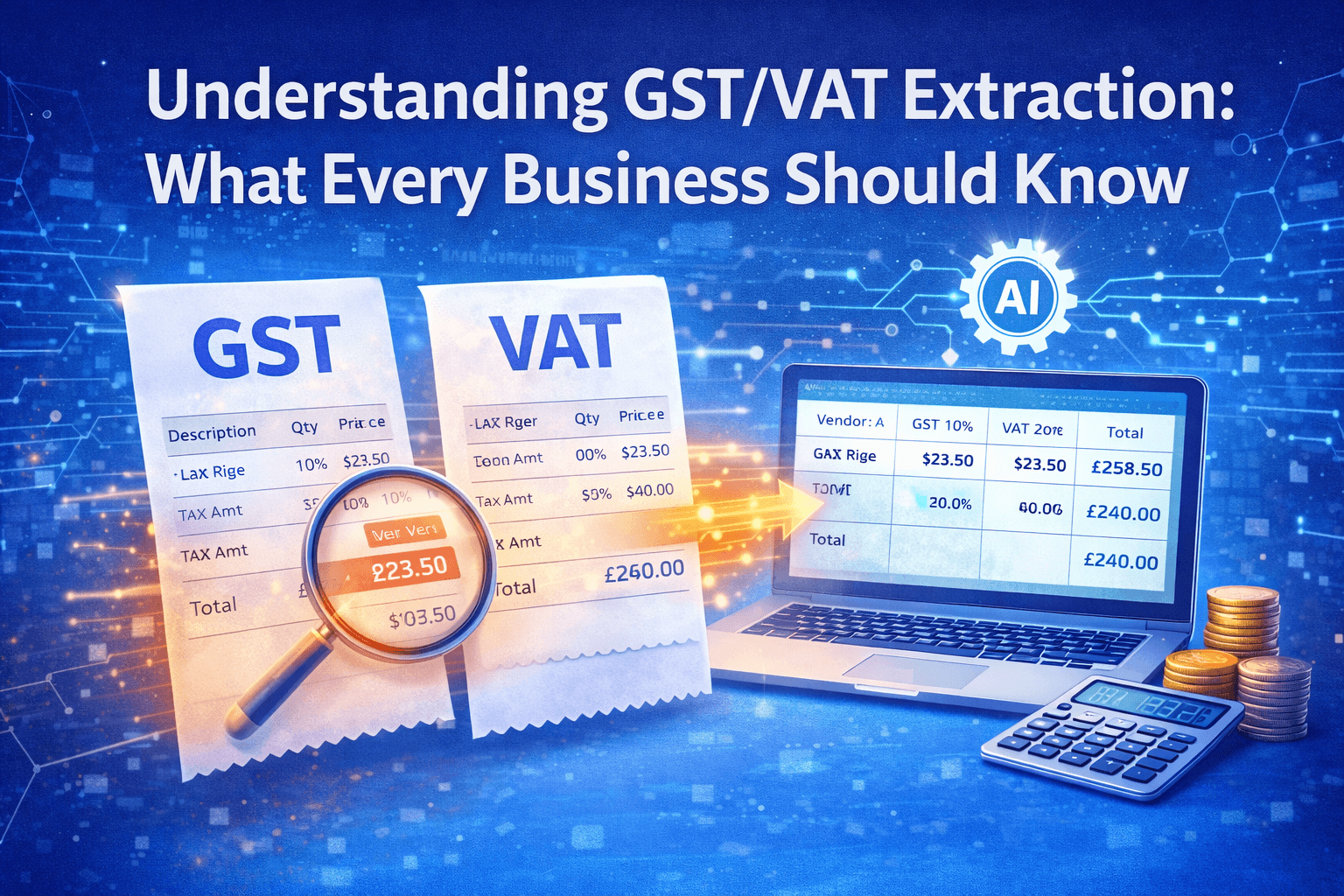
GST/VAT extraction is the process of identifying and capturing tax-related information from invoices, such as:
Taxable amount
GST or VAT rate
Tax amount
Total amount including tax
This data is essential for:
Tax filings
Expense reconciliation
Audit readiness
Financial reporting
Accurate extraction ensures businesses neither underpay nor overpay taxes.
Why Accurate GST/VAT Extraction Matters
1. Tax Compliance
Incorrect tax data can lead to:
Filing errors
Penalties and fines
Audit risks
Accurate extraction helps ensure compliance with local tax regulations.
2. Financial Accuracy
GST/VAT directly affects:
Profit and loss statements
Expense categorization
Cash flow tracking
Even small errors can add up over time.
3. Audit Readiness
Auditors often require:
Proof of tax amounts
Supporting invoices
Clear breakdowns of taxable vs non-taxable items
Digitally extracted and stored tax data simplifies audits significantly.
Common Challenges With Manual GST/VAT Extraction
Businesses relying on manual processes often face:
Inconsistent invoice formats
Multiple tax rates on a single invoice
Missing or unclear tax labels
Human data-entry errors
Difficulty handling international invoices
These challenges increase as invoice volumes grow.
How GST/VAT Appears on Invoices
GST/VAT information may appear in different ways depending on the region and vendor:
As a single tax line
As line-item-level tax
As multiple tax components
Embedded in totals
This variation makes rule-based extraction difficult.
Traditional OCR vs AI-Based Tax Extraction
Traditional OCR
Reads text only
Cannot reliably identify tax fields
Struggles with layout variations
AI-Based Extraction
Understands invoice structure
Identifies tax labels and values
Validates totals and tax calculations
Handles multiple formats and currencies
AI-based systems significantly improve tax extraction accuracy.
How Automation Improves GST/VAT Accuracy
Automation helps by:
Detecting tax sections automatically
Cross-checking tax totals against line items
Identifying missing or inconsistent values
Reducing manual review time
This results in faster processing and fewer errors.
How DocuNero Handles GST/VAT Extraction
DocuNero uses AI-powered document understanding to extract GST and VAT data accurately from invoices.
Key capabilities include:
Automatic detection of tax fields
Support for multiple tax rates
Validation against invoice totals
Structured tax data ready for export
Compatibility with scanned and digital invoices
This helps businesses maintain accurate tax records without manual effort.
Who Benefits Most From Automated GST/VAT Extraction?
Automated tax extraction is especially useful for:
Small and medium businesses
Accounting and finance teams
Companies with high invoice volumes
Businesses operating across regions
Any organization aiming to reduce tax-related errors benefits from automation.
Best Practices for GST/VAT Management
Digitize invoices as early as possible
Review extracted tax data periodically
Store invoices and tax records securely
Use tools that support regional tax rules
Maintain clear audit trails
These practices help ensure long-term compliance and efficiency.
When Should Businesses Automate GST/VAT Extraction?
Consider automation if:
Manual tax entry causes delays
Errors are discovered during reconciliation
Invoice volumes are increasing
Tax reporting feels stressful or inconsistent
Automation becomes more valuable as businesses scale.
Conclusion
GST/VAT extraction is a critical part of financial operations, yet it remains a common source of errors when handled manually. With varying invoice formats, tax rates, and regulations, businesses need more than basic OCR to stay compliant.
AI-powered extraction simplifies this process by improving accuracy, reducing manual work, and ensuring audit readiness. By adopting automated solutions, businesses can manage tax data confidently and focus on growth rather than paperwork.
Ready to get started with DocuNero?
Join thousands of users who trust us to automate their invoices and receipts with AI.
Start Free with DocuNeroAdmin
Admin at DocuNero, helping users simplify invoice and receipt processing through AI-powered automation.
View all posts by AdminRelated Posts
How to Extract Line Items From Invoices Automatically (Using AI)
Manually extracting invoice line items is slow and error-prone. Learn how AI automatically captures quantities, prices, taxes, and totals—accurately and at scale.

OCR vs Manual Data Entry: Accuracy, Speed & Cost Comparison (2025 Edition)
Manual data entry is slow, expensive, and error-prone. This guide compares manual work with modern OCR + AI automation to show which method wins in 2025.