How a Retail Business Saves Hours Monthly Using AI Scanning Tools
 Admin5 min read
How a Retail Business Saves Hours Monthly Using AI Scanning Tools
Introduction
Retail businesses run on thin margins and high transaction volumes. Every day, finance teams deal with supplier invoices, purchase receipts, freight charges, utilities, and payment confirmations. While sales systems are often automated, back-office document handling is still surprisingly manual. This gap creates inefficiencies that compound every month.
Many retailers still rely on spreadsheets and manual entry for invoice and receipt processing. As a result, month-end close becomes stressful, reconciliation takes longer than expected, and finance teams spend more time fixing errors than analyzing performance.
The Reality of Retail Finance Operations
A typical retail business processes documents from multiple sources every week. Supplier invoices arrive in PDFs, receipts are submitted as photos, and bank transactions come from multiple accounts. Each document uses a different layout, currency, and tax structure. When this data is entered manually, inconsistencies are inevitable.
These inconsistencies often surface during reporting or reconciliation, which is why many retail finance teams struggle with delayed close cycles. As transaction volumes grow, businesses begin searching for ways to streamline operations such as automating month-end reconciliation without increasing headcount.
Where Retail Businesses Lose the Most Time
Retail finance teams usually lose hours every month in three predictable areas.
The first is invoice processing. Supplier invoices vary widely in format, and manually extracting totals, taxes, and line items is slow. Many teams still rely on spreadsheets instead of modern approaches like automated invoice line-item extraction, which can standardize data across vendors.
The second area is receipt handling. Paper receipts fade, get lost, or are submitted late, making expense tracking unreliable. Retailers that prioritize receipt digitization early in the workflow see immediate improvements in accuracy and traceability.
The third area is document conversion. Converting PDFs into spreadsheets manually often breaks formatting and introduces errors, which is why many teams are replacing traditional methods with AI-powered PDF to Excel conversion to preserve structure and reduce rework.
Why Manual Processes Don’t Scale in Retail
Retail businesses scale quickly. New suppliers, new locations, and higher transaction volumes all increase document load. Unfortunately, manual processes scale linearly with volume, meaning more documents require more staff time.
This creates a bottleneck during reporting and reconciliation. Without clean, structured data, finance teams spend days correcting issues that should have been prevented earlier in the workflow. This is why clean financial data is now widely recognized as foundational, echoing the principles explained in why clean financial data matters for accountants and bookkeepers.
How AI Scanning Tools Change the Retail Workflow
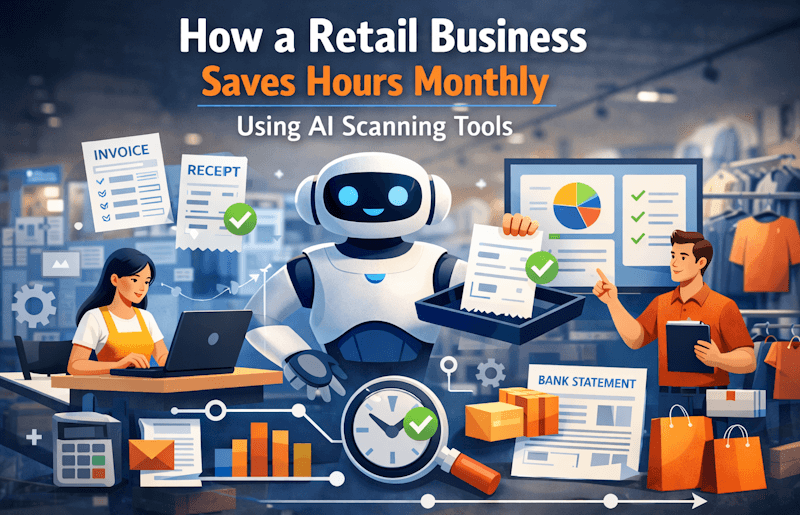
AI scanning tools fundamentally change how retail businesses handle documents. Instead of treating invoices and receipts as static files, AI systems understand document layouts, extract structured data, and validate totals automatically.
This approach ensures that invoice amounts, taxes, and currencies are captured consistently. When combined with accurate bank statement parsing, transaction data can be matched reliably, reducing reconciliation effort significantly.
A Realistic Retail Use Case
Consider a mid-sized retail business with multiple suppliers and daily expenses. Before automation, the finance team spent several hours every week entering invoice data, categorizing receipts, and matching bank transactions manually.
After adopting AI scanning tools, invoices were processed automatically, receipts were digitized at submission, and bank transactions were parsed into structured records. Reconciliation no longer required line-by-line checks, and month-end close became predictable instead of stressful. This shift allowed the finance team to focus on insights rather than data cleanup.
Faster Reconciliation Through Structured Data
Reconciliation becomes dramatically easier when financial data is structured from the start. Instead of searching for missing invoices or correcting mismatched totals, finance teams can rely on validated records.
Improved Expense Categorization and Visibility
Retail businesses often struggle with inconsistent expense categorization, especially when receipts are processed manually. AI scanning tools improve categorization by extracting merchant details, dates, and tax information consistently.
Accurate categorization supports better reporting and analysis, aligning with expense categorization best practices for small businesses and helping retailers understand where money is actually being spent.
Audit Readiness and Compliance Benefits
Retailers are frequently subject to audits, tax reviews, and compliance checks. When documents are stored inconsistently, audit preparation becomes time-consuming and risky.
AI-driven document processing creates a clear audit trail by linking structured data back to original invoices, receipts, and bank records. This aligns with widely accepted data quality principles that emphasize accuracy, consistency, and traceability.
How DocuNero Supports Retail Automation
DocuNero helps retail businesses automate document handling by converting invoices, receipts, and bank statements into structured, validated financial data. By reducing manual entry and enforcing consistency, DocuNero enables retailers to scale operations without increasing administrative overhead.
Retailers using DocuNero benefit from improved reconciliation, cleaner exports, and more reliable reporting across locations and suppliers.
Measurable Time Savings for Retail Teams
Retail businesses adopting AI scanning tools commonly save several hours every month. These savings come from reduced data entry, fewer corrections, and faster reconciliation cycles. Over time, these gains compound, making automation a strategic investment rather than a short-term efficiency fix.
When Retailers Should Adopt AI Scanning Tools
Retailers should consider AI scanning tools when invoice volumes increase, reconciliation delays become common, or finance teams spend more time on manual tasks than analysis. Early adoption ensures smoother scaling and better financial control as the business grows.
Best Practices for Successful Adoption
Retailers achieve the best results when they digitize documents early, standardize categories, validate extracted data regularly, and integrate structured outputs directly into accounting workflows. Continuous review ensures that automation remains accurate as suppliers and transaction volumes change.
Conclusion
Retail businesses face constant pressure to operate efficiently while managing high transaction volumes. Manual document processing no longer scales in this environment. AI scanning tools provide a practical way to automate invoice and receipt handling, reduce reconciliation effort, and save hours every month.
By adopting intelligent document processing and building workflows around clean, structured data, retailers can transform finance operations from reactive to proactive. As retail complexity grows, AI-driven automation becomes not just a convenience, but a competitive advantage.
Ready to get started with DocuNero?
Join thousands of users who trust us to automate their invoices and receipts with AI.
Start Free with DocuNeroAdmin
Admin at DocuNero, helping users simplify invoice and receipt processing through AI-powered automation.
View all posts by Admin